A few months ago, there was concern that our homicide rate was out of control. If you look at our daily homicide analysis, you will see we have just four more homicides than at this time last year and are at or below where we were for the three years before that. Each of these killings is a tragedy, but I assure you that violence is not spiraling out of control. The murder rate in Kansas City has remained relatively constant for a number of years.
My No. 1 priority as chief has been to reduce violent crime. We have studied where crime is most likely to occur and have devoted a great deal of resources to those neighborhoods. About half of this year’s homicides have occurred in several defined areas or within a few blocks of them. Starting the first weekend of May, we pulled officers from all over the department to saturate these areas. Since that time, no killings have taken place in those communities with the exception of an officer-involved shooting.
We’ve also made a concentrated effort to get guns out of the hands of those who should not legally have them. Through the beginning of May, our Narcotics and Vice Division has recovered 208 percent more firearms than at this point last year. This includes 573 percent more assault weapons (74 vs. 11) and 131 percent more handguns (367 vs. 119) than at this point in 2011.
This enhanced enforcement activity has not led to the displacement of crime elsewhere. None of our data show that violence is moving to other areas.
The police cannot take all credit for this progress. The people living in these neighborhoods have really stepped up. They are cooperating with us more and are becoming less tolerant of crime where they live.
Enhanced cooperation between police and residents as well as more law enforcement resources in the areas that need them most means that summer – a time of typically higher violence – can be a time of peace and safety in Kansas City.
Send comments to kcpdchiefblog@kcpd.org.

Monday, June 4, 2012
Friday, June 1, 2012
All Star Game security plan gets military "Red Team" review
PRESS RELEASE:
The Kansas City Police security plan for the Major League Baseball All Star Game has received a military review from people who instruct U.S. Army officers how to review battle plans.
Instructors and students at the University of Foreign Military and Cultural Studies at Fort Leavenworth volunteered to analyze the plan and met Thursday with members of KCPD, Kansas City Fire and Emergency Management Departments, the FBI, Department of Homeland Security and the Kansas City Royals at Kauffman Stadium to report their findings in a process called “Red Teaming.”
“We wanted them to find the things we didn’t think of and point out the vulnerabilities in the plan,” Major Rich Lockhart said.
The Red Team concept arose about six years ago from lessons learned in Iraq and Afghanistan, said Retired Army Col. Steve Rotkoff, deputy director of the University of Foreign Military and Cultural Studies at Fort Leavenworth. The Army found groupthink had taken over in a lot of situations, and an outside perspective was needed to really analyze military strategies.
“A Red-Teamer is someone who has been trained, educated and given the tools to serve as an in-house skeptic,” Rotkoff said.
That was exactly what police wanted going into the All Star game, Lockhart said – an outside perspective to find any holes in the security plan.
Five U.S. Army officers – majors and above – in the Red Team Course analyzed the All Star plan. Rotkoff said it was one of the few civilian plans they’ve ever reviewed.
“They confirmed for us this is a solid plan,” Lockhart said. “They made some really good suggestions; like that we should have a no-communications plan in the event radios and cell phones don’t work. We’re going to work on putting that together next week.”
The Kansas City Police security plan for the Major League Baseball All Star Game has received a military review from people who instruct U.S. Army officers how to review battle plans.
Instructors and students at the University of Foreign Military and Cultural Studies at Fort Leavenworth volunteered to analyze the plan and met Thursday with members of KCPD, Kansas City Fire and Emergency Management Departments, the FBI, Department of Homeland Security and the Kansas City Royals at Kauffman Stadium to report their findings in a process called “Red Teaming.”
“We wanted them to find the things we didn’t think of and point out the vulnerabilities in the plan,” Major Rich Lockhart said.
The Red Team concept arose about six years ago from lessons learned in Iraq and Afghanistan, said Retired Army Col. Steve Rotkoff, deputy director of the University of Foreign Military and Cultural Studies at Fort Leavenworth. The Army found groupthink had taken over in a lot of situations, and an outside perspective was needed to really analyze military strategies.
“A Red-Teamer is someone who has been trained, educated and given the tools to serve as an in-house skeptic,” Rotkoff said.
That was exactly what police wanted going into the All Star game, Lockhart said – an outside perspective to find any holes in the security plan.
Five U.S. Army officers – majors and above – in the Red Team Course analyzed the All Star plan. Rotkoff said it was one of the few civilian plans they’ve ever reviewed.
“They confirmed for us this is a solid plan,” Lockhart said. “They made some really good suggestions; like that we should have a no-communications plan in the event radios and cell phones don’t work. We’re going to work on putting that together next week.”


Wednesday, May 30, 2012
What's been in my e-mail inbox lately
In just the last two weeks, I have received multiple e-mails from residents praising members of this department. Several had gone on ride-alongs and were impressed to see how officers conduct themselves on a day-to-day basis. Others were pleased with the way officers resolved a situation. I wanted to share some of these messages with you:
From a woman whose car stereo was stolen last fall and didn’t expect to get it back:
I was very surprised to receive a call from Detective Herriman on May 14th that our stereo had been located in a pawn shop. He explained what actions I could take, and when I expressed that I did not want to press charges, but was unsure about contacting the owner myself, he told me that he might be able to retrieve the stereo with me, which was great because we had never replaced it. He asked if I could meet him at the pawn shop, and I explained that my husband had just had surgery, and I had been told not to leave him alone for the first few days of recovery. He then told me that he could drop the stereo off at our home that same afternoon. I was really shocked by how helpful he was, especially for such a small item!
Not only was Detective Herriman extremely helpful and friendly, but I think it's really incredible that pawn shops and other retailers are being checked for stolen goods. Even though property crimes like these are minor offenses, it really does increase my sense of safety at how thorough the police force in Kansas City is. Thank you so much for all you do, especially Detective Herriman!
From a woman who did a ride-along in the Metro Patrol Division on May 21
We hear a great deal of media coverage regarding Kansas City’s exploding homicide rate and, understandably, it deserves the media’s attention. But, we rarely hear about the outstanding service our KMCO Police Officers provide day-in-and-day-out. They are the first responders – they put their own lives on the line every day to protect our citizenry and, unfortunately, they receive little public recognition for their tremendous effort.
I watched Officer Grizzoffi deal with a mother of four, living in deplorable conditions, and yet he was kind and considerate of her circumstances. As the night progressed I saw him interact with numerous individuals who would push the limit of tolerance for many individuals, including myself. I observed Officer Grizzoffi assist 2 other officers with the detainment and arrest of a habitual criminal calmly and professionally. And I was moved by Officer Grizzoffi’s effort to reach out to a troubled woman who had attempted suicide with compassion and sympathy.
Nothing I do professionally, on any given day, no matter how “taxing” I find it to be, can compare to what our police officers face on a daily basis. I am very thankful we are protected by exceptional policemen, like Officer Grizzoffi.
From a woman who lives in South Kansas City:
I'd just like to say thanks to all the officers, in cars and on horses, who did such a great job peacefully dispelling the very large group of kids attempting to overrun the 7-11 at Blue Ridge Blvd and 107th Street around noon on Wednesday, May 23rd! Their approach and plan was just perfect, and their professionalism evident.
From a man who went on a ride-along in the South Patrol Division on May 11:
I would like to thank you for the opportunity to participate in the Ride Along program this past May 11. I would also like to commend the officer that I accompanied, Officer Cooper and his partner, Jason. It was a terrific learning experience for me and gave me insight into the challenges the police on the street face every day. Officer Cooper displayed sharp reaction in a difficult domestic violence situation and handled it with poise. Both of these officers showed a clear understanding of the law they are assigned to uphold and are attentive to the procedures required to fulfill case duty.
Send comments to kcpdchiefblog@kcpd.org.
From a woman whose car stereo was stolen last fall and didn’t expect to get it back:
I was very surprised to receive a call from Detective Herriman on May 14th that our stereo had been located in a pawn shop. He explained what actions I could take, and when I expressed that I did not want to press charges, but was unsure about contacting the owner myself, he told me that he might be able to retrieve the stereo with me, which was great because we had never replaced it. He asked if I could meet him at the pawn shop, and I explained that my husband had just had surgery, and I had been told not to leave him alone for the first few days of recovery. He then told me that he could drop the stereo off at our home that same afternoon. I was really shocked by how helpful he was, especially for such a small item!
Not only was Detective Herriman extremely helpful and friendly, but I think it's really incredible that pawn shops and other retailers are being checked for stolen goods. Even though property crimes like these are minor offenses, it really does increase my sense of safety at how thorough the police force in Kansas City is. Thank you so much for all you do, especially Detective Herriman!
From a woman who did a ride-along in the Metro Patrol Division on May 21
We hear a great deal of media coverage regarding Kansas City’s exploding homicide rate and, understandably, it deserves the media’s attention. But, we rarely hear about the outstanding service our KMCO Police Officers provide day-in-and-day-out. They are the first responders – they put their own lives on the line every day to protect our citizenry and, unfortunately, they receive little public recognition for their tremendous effort.
I watched Officer Grizzoffi deal with a mother of four, living in deplorable conditions, and yet he was kind and considerate of her circumstances. As the night progressed I saw him interact with numerous individuals who would push the limit of tolerance for many individuals, including myself. I observed Officer Grizzoffi assist 2 other officers with the detainment and arrest of a habitual criminal calmly and professionally. And I was moved by Officer Grizzoffi’s effort to reach out to a troubled woman who had attempted suicide with compassion and sympathy.
Nothing I do professionally, on any given day, no matter how “taxing” I find it to be, can compare to what our police officers face on a daily basis. I am very thankful we are protected by exceptional policemen, like Officer Grizzoffi.
From a woman who lives in South Kansas City:
I'd just like to say thanks to all the officers, in cars and on horses, who did such a great job peacefully dispelling the very large group of kids attempting to overrun the 7-11 at Blue Ridge Blvd and 107th Street around noon on Wednesday, May 23rd! Their approach and plan was just perfect, and their professionalism evident.
From a man who went on a ride-along in the South Patrol Division on May 11:
I would like to thank you for the opportunity to participate in the Ride Along program this past May 11. I would also like to commend the officer that I accompanied, Officer Cooper and his partner, Jason. It was a terrific learning experience for me and gave me insight into the challenges the police on the street face every day. Officer Cooper displayed sharp reaction in a difficult domestic violence situation and handled it with poise. Both of these officers showed a clear understanding of the law they are assigned to uphold and are attentive to the procedures required to fulfill case duty.
Send comments to kcpdchiefblog@kcpd.org.
Thursday, May 24, 2012
Take-home police vehicles benefit communities, public safety
A police car in a neighborhood can go a long way toward
preventing crime. That’s one of many reasons I support our department’s use of
take-home vehicles. They increase police visibility, increase safety and
improve response times to critical incidents. As resources permit, I plan to
assign take-home vehicles to officers who reside in areas where there is a high
incidence of crime to increase police visibility in hopes of reducing crime and
building relationships. Eventually, I would like all patrol officers to be
assigned take-home vehicles.
On May 17, an off-duty detective was driving his take-home
vehicle in the Northland when he witnessed an armed robbery. He followed the
suspects to Truman and Paseo, where patrol officers helped arrest them. The
robbery victims were not injured, and the suspects have been charged. This is
just one of many examples of how these cars are used to protect the public. Who
knows how many other crimes would have occurred had that detective not
intervened? Those suspects could have robbed and hurt many others throughout
the city.
By being alert and having his police vehicle, that detective
was able to stop armed robbers, even though he wasn’t on the clock. Homicide
detectives, Tactical Response Team officers and many others get called out at
all times of the day, and take-home vehicles get them there quickly to speak
with as many witnesses as possible and/or to protect the public. A few years
ago, when there was an active shooter at Ward Parkway Center, I was off duty
but able to arrive on scene within several minutes because I had a take-home
car.
And just having police cars out and about in the city brings
a sense of security among law-abiding citizens and a sense of uneasiness among
those who commit crimes. This article from Government Fleet magazine does a good job outlining the many benefits of
police take-home vehicles.
Take-home vehicle use is carefully monitored so it is not
abused. These vehicles and those who use them are audited every year to
determine whether each vehicle’s use is justified. You can read those audits
here.
You also can see our policy governing take-home vehicle use here.
Keep in mind that audits of take-home vehicles do not examine feelings of
safety, improved relationships or other benefits of having police vehicles that
are readily available to respond to critical incidents.
As long as police take-home vehicles continue to prevent
crime and allow for quick response times, you will continue to see them on the
streets of Kansas City.
Send comments to kcpdchiefblog@kcpd.org.
Monday, May 21, 2012
New recruits reflect community
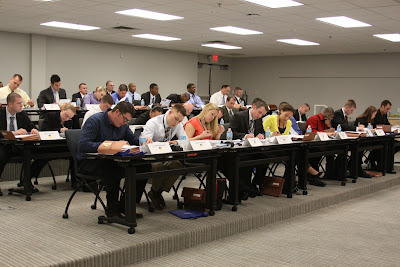
Thirty-four men and women are beginning the process today to become Kansas City Missouri Police officers. Today, they are filling out paperwork, getting their equipment issued and undergoing orientation. Tomorrow will be their first day at the Police Academy as part of our nearly eight-month training program.
This group represents the community they will serve well. A third of them are minorities (nine are black and two are Hispanic), and 20 percent of them are women. I thank our Human Resources Unit for recruiting and processing such qualified and diverse candidates.
I look forward to watching these men and women become Kansas City Police Officers.


Send comments to kcpdchiefblog@kcpd.org.
This group represents the community they will serve well. A third of them are minorities (nine are black and two are Hispanic), and 20 percent of them are women. I thank our Human Resources Unit for recruiting and processing such qualified and diverse candidates.
I look forward to watching these men and women become Kansas City Police Officers.


Send comments to kcpdchiefblog@kcpd.org.
Friday, May 18, 2012
Hot spot policing is about more than just enforcing laws
I told you earlier about how we were stepping up police presence in hot spot areas where nearly half of the city's crime takes place. I wanted to show you that this doesn't necessarily mean just arresting a lot of people. It is equally important to build relationships and trust.
This past weekend, several officers bought popsicles and delivered them to children and families in one of the hot spots. They ended up getting engaged in a few games of street basketball. The officers lost three games in a row, but everyone had a good time. Those residents who were hanging out with the police were truly grateful that they're trying to make their neighborhood safer. The pictures below were taken by a sergeant on his cell phone.


This past weekend, several officers bought popsicles and delivered them to children and families in one of the hot spots. They ended up getting engaged in a few games of street basketball. The officers lost three games in a row, but everyone had a good time. Those residents who were hanging out with the police were truly grateful that they're trying to make their neighborhood safer. The pictures below were taken by a sergeant on his cell phone.


Wednesday, May 16, 2012
Police Memorial Service is tomorrow
PRESS RELEASE:
The Kansas City Missouri Police Department will honor its 119 officers killed in the line of duty throughout the department’s history with a Memorial Service beginning at 10 a.m. Thursday, May 17, in front of Police Headquarters on Locust Street, between 11th and 12th streets.
The service will include an honor guard, a 21-gun salute from the steps of City Hall, the KCPD Color Guard, bagpipers, a flyover by the police helicopter, and a riderless horse representing fallen officers. Communications Unit Supervisor L.C. Clark will read the names of all KCPD officers killed in the line of duty – the first in 1881 and the last in 2001. There will be 119 flags on display in front of Headquarters representing each one of these officers. For 119 hours preceding the service, dispatchers read one officer’s name per hour over the police radio system. The last officer’s name, Craig Schultz, will be read immediately before the ceremony begins Thursday.
Locust will be closed between 11th and 12th streets from about 7 a.m. to noon for the ceremony. In the event of rain, the ceremony will take place inside the basement of police headquarters, which can be accessed from 12th Street. The public is invited to attend.
The Kansas City Missouri Police Department will honor its 119 officers killed in the line of duty throughout the department’s history with a Memorial Service beginning at 10 a.m. Thursday, May 17, in front of Police Headquarters on Locust Street, between 11th and 12th streets.
The service will include an honor guard, a 21-gun salute from the steps of City Hall, the KCPD Color Guard, bagpipers, a flyover by the police helicopter, and a riderless horse representing fallen officers. Communications Unit Supervisor L.C. Clark will read the names of all KCPD officers killed in the line of duty – the first in 1881 and the last in 2001. There will be 119 flags on display in front of Headquarters representing each one of these officers. For 119 hours preceding the service, dispatchers read one officer’s name per hour over the police radio system. The last officer’s name, Craig Schultz, will be read immediately before the ceremony begins Thursday.
Locust will be closed between 11th and 12th streets from about 7 a.m. to noon for the ceremony. In the event of rain, the ceremony will take place inside the basement of police headquarters, which can be accessed from 12th Street. The public is invited to attend.
Tuesday, May 15, 2012
The Kansas City No Violence Alliance
Today I joined several of our partners in announcing KC NoVA – the Kansas City No Violence Alliance. This focused deterrence law enforcement initiative seeks to reduce violent crime in Kansas City and is a partnership between the Kansas City Police Department, Jackson County Prosecutor’s Office, City of Kansas City, U.S. Attorney’s Office and Missouri Board of Probation and Parole.
The National Institutes of Justice define focused deterrence as “A crime prevention program that targets a specified crime problem by applying a concentrated strategy or tactic within a specified high-crime-intensity area. That is, intense traffic enforcement within a high-crime area will have a general deterrence effect, but intense traffic enforcement that uses a specified approach to stop only suspicious individuals within a highly defined area.”
A similar approach has seen success in other cities like Boston, Minneapolis, Los Angeles and Rochester, N.Y. We took the best of those models and have put them together here in Kansas City.
The leaders of these partnership agencies have been meeting since January to determine the best way to address violent crime. This is one piece of many, but it is a significant one. The ultimate goal is to reduce the number of victims. To do so, the idea is to go after the most violent criminals we have in Kansas City. We have a list of about 20 right now (that list changes as some are murdered or incarcerated). We will work hard to get firearms out of the hands of those who should not legally possess them. Eighty-three percent of this year’s homicides have been carried out with a gun.
For less violent offenders – and those who can be reached outside the criminal justice system – we want to give them opportunities. This can be everything from job training to anger management. Social services will be a big piece of KC NoVA.
Police will not take a “zero-tolerance” approach in communities devastated by violent crime. We will be respectful and professional. But we will go after the most violent offenders. We will map out who they know and determine the best ways to prosecute them in such a way that they will no longer pose a risk to the community.
Much appreciation is due Greater Kansas LISC, which secured a $74,000 grant for KC NoVA. About $44,000 will go to hiring a manager for the project. The other $30,000 will go to the University of Missouri Kansas City’s Department of Criminology. UMKC will begin the project by doing some extensive research. Through interviews with community members and law enforcement, faculty will conduct a social networking analysis that identifies individuals known to be committing or contributing to neighborhood violence. The analysis also will map all the linkages between these individuals, including informal alliances or disputes.
Individuals who sincerely want to choose a new path will be offered services to help them. Those who don’t will be severely prosecuted.
Anytime we try something new, there are critics. Those who say, “It’s just another program.” But we aim for this to be sustainable and effective. It may take a year or more to see results, but I am confident it ultimately will lead to a safer Kansas City.
Send comments to kcpdchiefblog@kcpd.org.
The National Institutes of Justice define focused deterrence as “A crime prevention program that targets a specified crime problem by applying a concentrated strategy or tactic within a specified high-crime-intensity area. That is, intense traffic enforcement within a high-crime area will have a general deterrence effect, but intense traffic enforcement that uses a specified approach to stop only suspicious individuals within a highly defined area.”
A similar approach has seen success in other cities like Boston, Minneapolis, Los Angeles and Rochester, N.Y. We took the best of those models and have put them together here in Kansas City.
The leaders of these partnership agencies have been meeting since January to determine the best way to address violent crime. This is one piece of many, but it is a significant one. The ultimate goal is to reduce the number of victims. To do so, the idea is to go after the most violent criminals we have in Kansas City. We have a list of about 20 right now (that list changes as some are murdered or incarcerated). We will work hard to get firearms out of the hands of those who should not legally possess them. Eighty-three percent of this year’s homicides have been carried out with a gun.
For less violent offenders – and those who can be reached outside the criminal justice system – we want to give them opportunities. This can be everything from job training to anger management. Social services will be a big piece of KC NoVA.
Police will not take a “zero-tolerance” approach in communities devastated by violent crime. We will be respectful and professional. But we will go after the most violent offenders. We will map out who they know and determine the best ways to prosecute them in such a way that they will no longer pose a risk to the community.
Much appreciation is due Greater Kansas LISC, which secured a $74,000 grant for KC NoVA. About $44,000 will go to hiring a manager for the project. The other $30,000 will go to the University of Missouri Kansas City’s Department of Criminology. UMKC will begin the project by doing some extensive research. Through interviews with community members and law enforcement, faculty will conduct a social networking analysis that identifies individuals known to be committing or contributing to neighborhood violence. The analysis also will map all the linkages between these individuals, including informal alliances or disputes.
Individuals who sincerely want to choose a new path will be offered services to help them. Those who don’t will be severely prosecuted.
Anytime we try something new, there are critics. Those who say, “It’s just another program.” But we aim for this to be sustainable and effective. It may take a year or more to see results, but I am confident it ultimately will lead to a safer Kansas City.
Send comments to kcpdchiefblog@kcpd.org.
Friday, May 11, 2012
KCPD Twitter account ranks in top five nationally
PRESS RELEASE:
The Kansas City Missouri Police Department’s Twitter account now ranks in the top five among large municipal police departments in the United States.
The International Association of Chiefs of Police (IACP) released the rankings this week. Click to see the full list. Kansas City comes in at No. 5 for municipal law enforcement agencies with 1,000 or more officers, behind Boston, New York City, Baltimore and Seattle. At the time the IACP released the rankings, Kansas City Police had 10,817 followers. They now have more than 11,100.
“Twitter has proved to be an excellent way for us to communicate with the people we serve,” Chief Darryl Forté said.
Live tweeting events – such as last month’s tweet along – have garnered many followers and given them a look behind the scenes of the police department. Another tweet along will take place in the near future.
KCPD shares breaking news and much more at www.twitter.com/kcpolice.
Send comments to kcpdchiefblog@kcpd.org.
The Kansas City Missouri Police Department’s Twitter account now ranks in the top five among large municipal police departments in the United States.
The International Association of Chiefs of Police (IACP) released the rankings this week. Click to see the full list. Kansas City comes in at No. 5 for municipal law enforcement agencies with 1,000 or more officers, behind Boston, New York City, Baltimore and Seattle. At the time the IACP released the rankings, Kansas City Police had 10,817 followers. They now have more than 11,100.
“Twitter has proved to be an excellent way for us to communicate with the people we serve,” Chief Darryl Forté said.
Live tweeting events – such as last month’s tweet along – have garnered many followers and given them a look behind the scenes of the police department. Another tweet along will take place in the near future.
KCPD shares breaking news and much more at www.twitter.com/kcpolice.
Send comments to kcpdchiefblog@kcpd.org.
Monday, May 7, 2012
Area command system deploying in Kansas City
Residents who live in “hot spot” areas should be seeing police presence stepped up in their neighborhoods. This weekend, we deployed additional resources on the streets as part of our area command system. We pulled officers and detectives from all over the department to staff the deployment. Some haven’t been out in the field for some time, but they have been put on special assignment to battle the scourge of violence in those areas.
I also have reassigned a Deputy Chief to oversee this deployment. He is the Designated Area Command Coordinator. His duties are, in part, bringing resources to the crime hot spot areas, monitoring activity in those areas and engaging department elements.
We experienced several successes with this deployment method over the weekend. In one incident, a suspect who had just shot somebody fled and was immediately apprehended by police who were in the area. That suspect has been charged.
The additional officers will answer 911 calls for service, but their primary goal is to proactively patrol these neighborhoods and deter violence. We want them to identify and arrest those who possess firearms illegally. We also want them to build trust with the law-abiding residents of these areas.
We know we are in the right place. More than 50 percent of this year’s homicides have occurred in two hot spot areas or within a couple blocks of them. This homicide phenomenon is not new, (in the last 40 years, there were just nine years in which Kansas City had fewer than 100 homicides), but this method of concentrating resources in a small area where we know crime is taking place is a new approach in our city.
I am concerned about the greater number of homicides so far this year compared to this time last year (39 vs. 27). Last year saw a spike of homicides in November, however, and we ended the year with 114. At this point in 2009, Kansas City had 41 homicides and ended the year with 110, which unfortunately, is about average. You can see that we are about on pace with the number of homicides in 2008, 2009 and 2010 by looking at our Daily Homicide Analysis. Just one homicide is one too many, however, and as you can see, police are doing everything they can to address violent crime.
In addition to more manpower, we’re deploying more technology. At a press conference on Friday, Congressman Emanuel Cleaver announced the partnership between the police department, Kansas City Area Transportation Authority and Federal Transit Administration to install ShotSpotter technology. This equipment will help police respond to the sound of gunshots much more quickly to apprehend shooters and assist victims.
This area command system is not a project or a program. It is the way we will do business: putting resources in the communities where they’re most needed. But police alone cannot prevent violence or homicides. The public must step up to decry the violence and cooperate with law enforcement. More and more have been doing that, which has led to increased clearance rates and dangerous people behind bars.
Send comments to kcpdchiefblog@kcpd.org.
I also have reassigned a Deputy Chief to oversee this deployment. He is the Designated Area Command Coordinator. His duties are, in part, bringing resources to the crime hot spot areas, monitoring activity in those areas and engaging department elements.
We experienced several successes with this deployment method over the weekend. In one incident, a suspect who had just shot somebody fled and was immediately apprehended by police who were in the area. That suspect has been charged.
The additional officers will answer 911 calls for service, but their primary goal is to proactively patrol these neighborhoods and deter violence. We want them to identify and arrest those who possess firearms illegally. We also want them to build trust with the law-abiding residents of these areas.
We know we are in the right place. More than 50 percent of this year’s homicides have occurred in two hot spot areas or within a couple blocks of them. This homicide phenomenon is not new, (in the last 40 years, there were just nine years in which Kansas City had fewer than 100 homicides), but this method of concentrating resources in a small area where we know crime is taking place is a new approach in our city.
I am concerned about the greater number of homicides so far this year compared to this time last year (39 vs. 27). Last year saw a spike of homicides in November, however, and we ended the year with 114. At this point in 2009, Kansas City had 41 homicides and ended the year with 110, which unfortunately, is about average. You can see that we are about on pace with the number of homicides in 2008, 2009 and 2010 by looking at our Daily Homicide Analysis. Just one homicide is one too many, however, and as you can see, police are doing everything they can to address violent crime.
In addition to more manpower, we’re deploying more technology. At a press conference on Friday, Congressman Emanuel Cleaver announced the partnership between the police department, Kansas City Area Transportation Authority and Federal Transit Administration to install ShotSpotter technology. This equipment will help police respond to the sound of gunshots much more quickly to apprehend shooters and assist victims.
This area command system is not a project or a program. It is the way we will do business: putting resources in the communities where they’re most needed. But police alone cannot prevent violence or homicides. The public must step up to decry the violence and cooperate with law enforcement. More and more have been doing that, which has led to increased clearance rates and dangerous people behind bars.
Send comments to kcpdchiefblog@kcpd.org.
Subscribe to:
Posts (Atom)